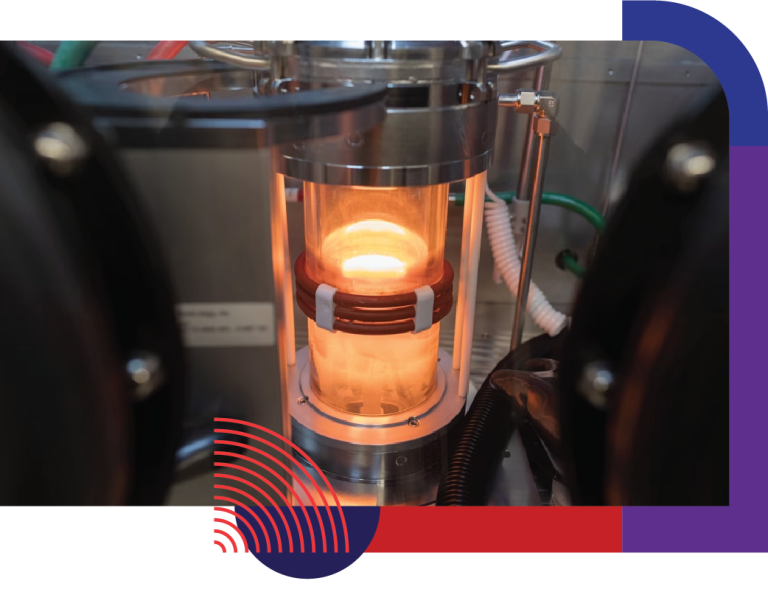
Our research is exploring what wide and ultra-wide bandgap semiconductors can really do. By working with materials like gallium nitride (GaN), aluminum gallium nitride (AlGaN), and aluminum nitride (AlN), we’re building devices that can handle higher voltages, faster speeds, and hotter temperatures—perfect for tough jobs in transportation, energy, aerospace, and communications.
These kinds of materials are a big deal for industries that need electronics to be more efficient and more durable. Whether it’s powering electric vehicles, managing renewable energy, or supporting high-frequency radar and wireless systems, we’re figuring out how to grow and design high-aluminum-content materials in ways that make them easier to manufacture and scale.
And we’re not just doing the research—we’re building the tools to make it real. With advanced fabrication and prototyping capabilities, we’re helping turn these materials into practical technologies. From growth to packaging, we’re working across the full stack to get new ideas out of the lab and into the world.
Research Faculty and Staff

Joseph Andrews
Position title: Alfred Fritz Assistant Professor
- Printed and flexible electronics
- Electronically transduced biosensors
- Print process control systems
- Electronics from nanomaterials
- Sensor design and validation
- Distributed sensing arrays
Chang-Beom Eom
Position title: Raymond R. Holton Chair for Engineering and Theodore H. Geballe Professor
Materials Science & Engineering
- Nanostructure fabrications of novel materials
- Hetroepitaxy of complex oxide thin films and heterostructures

Chirag Gupta
Position title: Assistant Professor
Electrical & Computer Engineering
- Semiconductor devices (WBG and UWBG)
- Group III-nitrides (GaN) and Oxides (GaOx)
- RF and power electronics: HEMTs and MOSFETs
- Optoelectronics (LEDs, LASERs)
- Lattice engineering
- Quantum applications

Mahima Gupta
Position title: Thomas A. Lipo Assistant Professor
Electrical & Computer Engineering
- Power electronics conversion & control
- Modular multi-level power converters
- Motor drive systems
- Application of wideband gap semiconductor devices
- Electromagnetic interference issues due to power electronics circuits

Charlie Hirst
Position title: Steven J. and Teresa M. Zinkle Nuclear Materials Assistant Professor
Nuclear Engineering & Engineering Physics
- Nuclear materials
- Radiation damage
- In situ experiments
- Coupled extremes
- Irradiation creep mechanisms
- Gradient experiments
- Thermal analysis
- Defect recovery stages
- Differential Scanning Calorimetry
- Stored energy

Akhilesh Jaiswal
Position title: Assistant Professor
Electrical & Computer Engineering
- Device-circuit co-design using existing and alternate state variables for future computing systems
- Processing-in-pixel and processing-in-sensor technology
- In-memory-computing
- Hardware-software co-design for efficient distributed computing
- Bio-inspired paradigms for sensing and compute, including neuromorphic systems
- Electro-optic general-purpose computing

Daniel Ludois
Position title: Jim and Anne Sorden Professor H.I. Romnes Fellow
Electrical & Computer Engineering
- Power electronics
- Electric machines
- Non-contact power transfer
- Sustainable engineering technologies and practices

Zhenqiang Ma
Position title: Lynn H. Matthias Professor in Engineering and Vilas Distinguished Achievement Professor
Electrical & Computer Engineering
- Lattice mis-matched semiconductor heterostructures: materials, physics and related various device applications
- Flexible/stretchable/wearable electronics/optoelectronics
- Bioelectronics (ECG/ECoG), neural and neuron interface engineering
- High-speed RF devices, optoelectronic devices and nanophotonics
- Semiconductor materials processing and heterogeneous integration
- Flexible electronics, flexible optoelectronics and flexible photonics
- Energy conversion semiconductor devices
- Bioelectronics and biomimetics
- Semiconductor device physics
- Power electronics
Luke Mawst
Position title: Grainger STAR Professor Emeritus in Engineering
- Semiconductor lasers
- Metalorganic chemical vapor deposition (MOCVD) growth of semiconductors
- III/V compound semiconductor materials and devices

Shubhra Pasayat
Position title: Assistant Professor
Electrical & Computer Engineering
- MOCVD growth of Group III-nitrides and Oxides
- Optoelectronics: Micro-LEDs, LASERs
- RF and Power Electronics: HEMTs and MOSFETs
- Bio-Photonics
- Lattice Engineering
- Quantum Materials
- Porous and flexible materials

Jinia Roy
Position title: Thomas A. Lipo Assistant Professor
Electrical & Computer Engineering
- Wideband gap based power converters for pulsed power, renewable, and EV applications
- Analysis, simulation, and experimental validation

Bulent Sarlioglu
Position title: Professor
Electrical & Computer Engineering
- Electric machines, drives, power electronics
- Electric actuation systems
- Automotive, aerospace, naval and renewable energy applications
- Complex and interdisciplinary power system architecture

Eric Tervo
Position title: Assistant Professor
Electrical & Computer Engineering
- Semiconductor materials and devices
- Thermal and luminescent electromagnetic radiation
- Solid-state thermal energy conversion devices
- Solar energy conversion
- Energy policy and economics

Dan van der Weide
Position title: Grainger Institute for Engineering Professor
Electrical & Computer Engineering
- Multifunctional scanned probe microscopy
- Localized spectroscopy of biological and low-dimensional electronic systems
- Terahertz circuits and devices
Giri Venkataramanan
Position title: Keith and Jane Morgan Nosbusch Professor in Engineering Education
Electrical & Computer Engineering
- Electrical power conversion systems
- Solar and wind energy technologies
- Battery energy storage systems
- Power systems for transportation
- Industrial drives and processes
- Microgrids and utility power distribution
- Empirical and analytical modeling of converters
- Technology equity and sustainable design

Paul Voyles
Position title: Harvey D. Spangler Professor
Materials Science & Engineering
- Electron microscopy, including aberration-corrected Z-contrast STEM, microanalysis by EDS and EELS, and coherent electron nanodiffraction
- Growth, structure, and defects in functional materials, including spintronics, oxide interfaces, and nanostructures
- Nanoscale order in glassy materials
Latest News
Built with today’s tech, new type of memory is key in the future of optical computing
Electrical engineers at the University of Wisconsin-Madison have developed and tested an integrated photonic memory chip, a key component in realizing ultrafast photonic computing. The chip—which leverages parts and fabrication techniques already in use by …
Entrepreneurship Hub announces SEED grant recipients
Six projects across four University of Wisconsin–Madison schools and colleges, including one to utilizing quantum sensors, have received annual State Economic Engagement & Development (SEED) funding, totaling $550,000. The SEED Research Program funds are designated by the state legislature and administered by …
$27M WARF investment fuels UW–Madison’s next frontiers in research
The gift aims to accelerate four high-impact research initiatives at the university: quantum technologies, brain health, fusion energy and national security. A $27 million investment from the Wisconsin Alumni Research Foundation (WARF) will accelerate four …
- More News