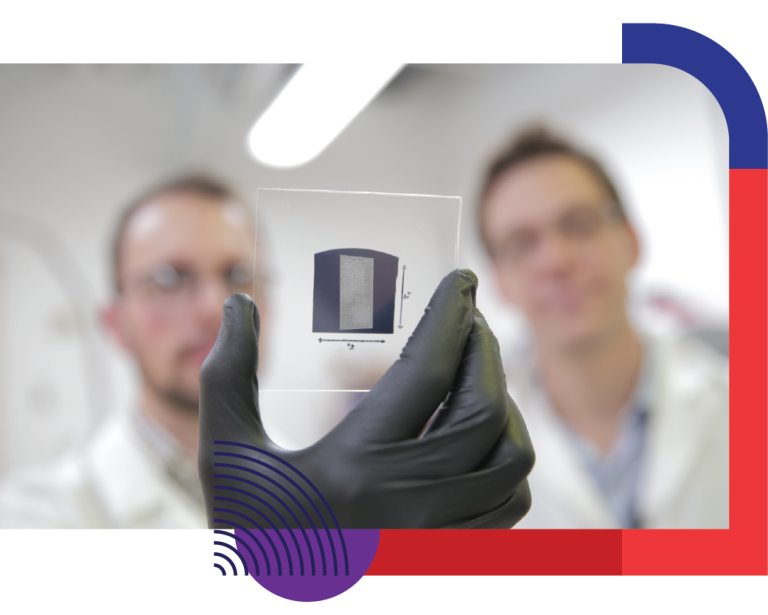
Working with carbon nanotubes, quantum materials, and spintronic devices, our Beyond Silicon researchers are developing technologies that increase processing speed, reduce power consumption, and maintain high performance.
These breakthroughs are reshaping how chips are built and how they function. A major milestone in aligning carbon nanotubes has opened the door to faster, more energy-efficient transistors and flexible electronics. Meanwhile, quantum and spintronic research is enabling new types of memory and computing systems that are faster, more secure, and less power-hungry.
The impact goes far beyond the labs. These innovations support high-performance computing, secure communications, and advanced memory systems. They help industries build smarter tools and systems, and they have real public benefit—from better medical diagnostics to stronger national defense.
Research Faculty and Staff

Chang-Beom Eom
Position title: Raymond R. Holton Chair for Engineering and Theodore H. Geballe Professor
Materials Science & Engineering
- Nanostructure fabrications of novel materials
- Hetroepitaxy of complex oxide thin films and heterostructures

Paul Evans
Position title: Professor
Materials Science & Engineering
- Ferroelectric and multiferroic materials: electric-field-driven structural control
- Superlattice domain dynamics: ultrafast switching behavior
- Photoinduced charge transfer: interface engineering for optoelectronics
- Advanced x-ray techniques: nanoscale probing of material properties

Daniel Fredrickson
Position title: Professor
- Intermetallic compounds: structure, bonding, and synthesis
- Quantum calculations: electronic structure and chemical principles
- Advanced crystallography: solving complex atomic arrangements
- Structure-property relationships: targeting superconductivity, thermoelectricity, and catalysis

Padma Gopalan
Position title: Associate Chair of Graduate Studies
Materials Science & Engineering
- Polymer Synthesis and Characterization
- Electro-optic and Photonic Materials
- Self-assembly of Block Copolymers
- Photonic Devices
- Liquid Crystalline Polymers

Jiamian Hu
Position title: Associate Professor
Materials Science & Engineering
- Phase-field modeling of microstructure evolution
- Machine learning for materials prediction
- Ferroelectric and magnetic dynamics at terahertz frequencies
- GPU-accelerated simulation tools for complex materials behavior
- Multiscale modeling of spin-lattice interactions and cavity magnonics

Song Jin
Position title: Professor
Materials Science and Engineering
- Physical and chemical properties of molecular-based materials
- Molecular electronics
- Nanoscale assembly techniques for molecular systems
- Chemical and structural characterization of surfaces
- Interfaces between inorganic materials and organic/biological materials

Jason Kawasaki
Position title: Associate Professor
Materials Science & Engineering
- Heteroepitaxy of novel materials
- Heusler compounds
- Magnetism
- Topological states
- Shape memory alloys
- Surfaces and interfaces
- MBE
- STM
- ARPES

Whitney Loo
Position title: Conway Assistant Professor
Chemical & Biological Engineering
- Polymers
- Soft materials
- Nanoscience
- Sustainability
- Energy storage

Dane Morgan
Position title: Harvey D. Spangler Professor of Engineering
Materials Science and Engineering
- Computational materials science for materials design
- Ab initio electronic structure and multiscale methods for large time / length scales and thermokinetics
- Ab initio based modeling of electrochemical systems and processes
- Machine learning techniques for accelerating materials analysis and discovery
- Application areas: Nuclear materials, Battery and fuel cell electrodes, electronic materials

Daniel Rhodes
Position title: Assistant Professor
Materials Science & Engineering
- Single crystal synthesis
- Superconductivity
- 2-D materials
- Topological materials (Dirac, Weyl, HOTI)
- Defect kinetics

Tiancheng Song
Position title: Assistant Professor
- 2D magnetism & moiré engineering
- Van der Waals spintronics & tunnel junctions
- 2D superconductivity & topological phases
- Quantum magnetometry & nanoscale imaging
- Spin-optoelectronics & photovoltaic effects
- Pressure- and voltage-controlled magnetic states

George Tzimpragos
Position title: James E. Smith Assistant Professor
Electrical & Computer Engineering
- Computer architecture
- Computing with novel technologies
- Brain-inspired computing

Jennifer Volk
Position title: John D. Wiley Assistant Professor
Electrical & Computer Engineering
- Superconducting logic
- Bio-based architectures
- Novel computing mediums

Paul Voyles
Position title: Harvey D. Spangler Professor
Materials Science & Engineering
- Electron microscopy, including aberration-corrected Z-contrast STEM, microanalysis by EDS and EELS, and coherent electron nanodiffraction
- Growth, structure, and defects in functional materials, including spintronics, oxide interfaces, and nanostructures
- Nanoscale order in glassy materials

Ying Wang
Position title: Dugald C. Jackson Assistant Professor
Electrical & Computer Engineering
- 2D quantum materials & heterostructures
- Nano-devices for energy, sensing, and information
- Exotic orders (e.g., domain walls, filaments) for data processing
- Magnon-based information carriers
- Multimodal characterization under extreme conditions

Jun Xiao
Position title: Assistant Professor
Materials Science & Engineering
- Photo-induced nonequilibrium phenomena, ferroelectric, magnetic, correlated, and topological transitions in quantum materials
- THz optoelectronic materials and devices for 6G communications
- 2D quantum materials and topological heterostructures for next-generation computing and sensing
- Ultrafast and nonlinear spectroscopy, THz circuits, Magneto-optics, phase engineering, 2D materials
Latest News
Built with today’s tech, new type of memory is key in the future of optical computing
Electrical engineers at the University of Wisconsin-Madison have developed and tested an integrated photonic memory chip, a key component in realizing ultrafast photonic computing. The chip—which leverages parts and fabrication techniques already in use by …
Entrepreneurship Hub announces SEED grant recipients
Six projects across four University of Wisconsin–Madison schools and colleges, including one to utilizing quantum sensors, have received annual State Economic Engagement & Development (SEED) funding, totaling $550,000. The SEED Research Program funds are designated by the state legislature and administered by …
$27M WARF investment fuels UW–Madison’s next frontiers in research
The gift aims to accelerate four high-impact research initiatives at the university: quantum technologies, brain health, fusion energy and national security. A $27 million investment from the Wisconsin Alumni Research Foundation (WARF) will accelerate four …
- More News