The gift aims to accelerate four high-impact research initiatives at the university: quantum technologies, brain health, fusion energy and national security.
A $27 million investment from the Wisconsin Alumni Research Foundation (WARF) will accelerate four high-impact research initiatives at the University of Wisconsin–Madison, building on existing strengths in quantum technologies, brain health, fusion energy and national security.
The gift comes at a pivotal moment as federal agencies and industry partners increase investments in these strategically important fields. The special investment will strengthen UW–Madison’s position as it diversifies its research funding portfolio in response to this rapidly changing funding landscape.
“These initiatives build on areas where UW–Madison already has exceptional expertise and momentum,” says Dorota Brzezińska, vice chancellor for research. “With WARF’s support, we can accelerate discovery, strengthen our leadership, attract new partnerships and expand the impact of UW–Madison research for Wisconsin and beyond by unlocking new opportunities to translate research discoveries into intellectual property, startup companies and economic impact.”
The investment will support cutting-edge interdisciplinary research spanning multiple schools and colleges. Among other initiatives, it will fund:
- The launch of three new research centers at the Wisconsin Quantum Institute aimed at transitioning quantum technologies from the lab to real-world uses. UW–Madison is a national leader in quantum computing, which holds the potential to greatly outperform classical computers in terms of speed and processing power.
- Crucial research aimed at discovering and testing advanced materials and manufacturing processes for future fusion power plants, along with the establishment of a new institute that will coordinate the university’s research, industry partnerships and public policy work related to fusion. As the promise of nearly limitless clean energy offered by fusion becomes closer to reality, the UW–Madison research community is uniquely positioned to leverage its decades of global leadership in the field.
- An initiative that will support the university’s growing research community investigating the use of psychoactive medicines to treat mental health conditions. The WARF funding will allow UW–Madison to build the operational infrastructure needed to coordinate these efforts to maximize their real-world impact on brain health.
- Expanded responsibilities for the Wisconsin Initiative on National Security, a new effort to coordinate and expand UW–Madison’s research pursuits that have both civilian applications and relevance to the federal government’s national security, defense and intelligence priorities.
“Federal and industry investment in national security focused technologies, particularly those that have dual civilian use, is accelerating,” says Erik Iverson, CEO of WARF. “Universities that move decisively to conduct such research will shape these fields for decades. WARF’s role is to fuel that momentum, so our world-class university can continue to lead in conducting cutting-edge research and developing highly impactful new technologies. Whether it’s quantum sensors for geo-positioning, brain health therapeutics, clean fusion energy, or other innovations , this is the WARF model: invest where discovery and impact intersect.”
Quantum technology at a critical moment
WARF’s investment will help the Wisconsin Quantum Institute (WQI) launch three new centers—Quantum Innovation Center, Quantum Sensing Center, and Quantum Applications Center—designed to accelerate the transition of quantum technologies from the laboratory to real-world applications in areas such as computing, communications, medical imaging and navigation.
While UW–Madison already holds leadership positions in several national quantum research centers, has launched venture-backed startup companies based on quantum technologies, and was home to the nation’s first master’s degree program in quantum science, researchers say the next phase of quantum development requires new capabilities.
“The day when quantum computers can perform specific, practical tasks better than classical machines is on the horizon,” says Mark Eriksson, professor of physics in the College of Letters & Science and CHIPS faculty. “Quantum sensors are already in prototype deployment. Governments around the world are positioning themselves for the accelerating race to lead the commercialization of these disruptive technologies.”
Led by Eriksson and WQI Executive Director Ona Ambrozaite, the three new centers will create a pipeline of new inventions, startups and industry partnerships while advancing technologies with applications across healthcare, agriculture, manufacturing, logistics and other sectors.
“Quantum technology is becoming a defining field of the 21st century,” Eriksson says.
• • •
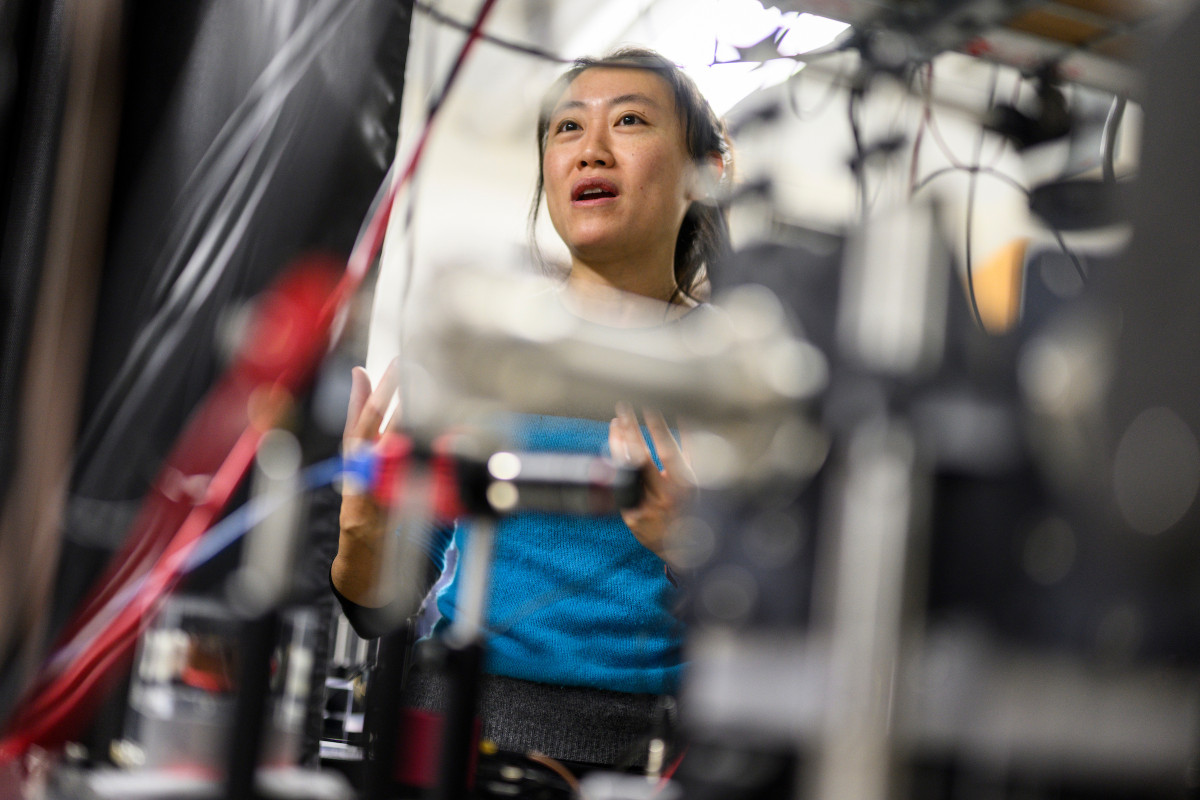
Featured image: Associate professor and CHIPS faculty Jennifer Choy’s research focuses on the development of quantum sensing platforms. Photo by Althea Dotzour/UW–Madison.
Written by: Natasha Kassulke
Originally published to UW News. Read the full article here.