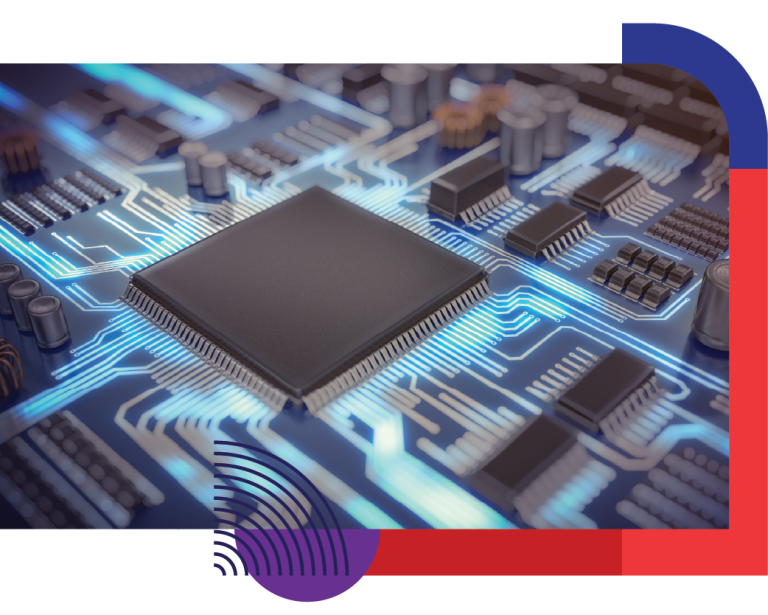
Our research in chiplet-based architectures and heterogeneous integration is reshaping how microelectronics are built—making them more flexible, efficient, and scalable for data-heavy applications like AI and machine learning.
Rather than relying on one big chip to do everything, we’re designing systems of smaller, specialized chiplets that work together—like assembling a team where each member has a specific role. But making that team function seamlessly takes serious engineering: managing heat, distributing power efficiently, and ensuring flawless communication between components.
And this isn’t just theory. We have already built energy-saving chiplet prototypes like the Mamba chiplet, showing measurable performance gains. Our students are learning these skills hands-on, and local companies are applying this research to accelerate product development and stay competitive.
Research Faculty and Staff

Azadeh Davoodi
Position title: Vilas Distinguished Achievement Professor and Associate Chair of Undergraduate Studies
Electrical & Computer Engineering
- Machine learning for better VLSI chip design
- VLSI design and automation for better machine learning
- IC-CAD for emerging nanotechnologies
- Hardware security
Tsung-Wei Huang
Position title: Associate Professor
Electrical & Computer Engineering
- Computer-aided design
- High-performance computing
- Quantum computing

Akhilesh Jaiswal
Position title: Assistant Professor
Electrical & Computer Engineering
- Device-circuit co-design using existing and alternate state variables for future computing systems
- Processing-in-pixel and processing-in-sensor technology
- In-memory-computing
- Hardware-software co-design for efficient distributed computing
- Bio-inspired paradigms for sensing and compute, including neuromorphic systems
- Electro-optic general-purpose computing
Umit Ogras
Position title: Gene Amdahl Professor
Electrical & Computer Engineering
- Domain-specific architectures
- Edge AI, Embedded Systems
- Mobile and Wearable Computing
- Multicore Architectures
- Flexible Hybrid Electronics

Hantang Qin
Position title: Assistant Professor
Industrial & Systems Engineering
- In-space manufacturing
- Additive manufacturing
- 3D printing
- Micro/nano manufacturing
- Electrohydrodynamic
- In-situ monitoring
- Quality engineering

Joshua San Miguel
Position title: Associate Professor
Electrical & Computer Engineering
- Approximate computing
- Processor microarchitecture
- Intermittent computing
- Energy-harvesting IoT devices
- Branch prediction
- Value prediction
- Cache architectures
- Networks-on-chip

Matt Sinclair
Position title: Assistant Professor
Electrical and Computer Engineering and Computer Sciences
- Heterogeneous computing systems
- GPU architecture & memory optimization
- High-performance software tools
- Parallel programming & operating systems
- Simulation tools (e.g., gem5, GPGPU-Sim)

Eric Tervo
Position title: Assistant Professor
Electrical & Computer Engineering
- Semiconductor materials and devices
- Thermal and luminescent electromagnetic radiation
- Solid-state thermal energy conversion devices
- Solar energy conversion
- Energy policy and economics

George Tzimpragos
Position title: James E. Smith Assistant Professor
Electrical & Computer Engineering
- Computer architecture
- Computing with novel technologies
- Brain-inspired computing

Dan van der Weide
Position title: Grainger Institute for Engineering Professor
Electrical & Computer Engineering
- Multifunctional scanned probe microscopy
- Localized spectroscopy of biological and low-dimensional electronic systems
- Terahertz circuits and devices

Jennifer Volk
Position title: John D. Wiley Assistant Professor
Electrical & Computer Engineering
- Superconducting logic
- Bio-based architectures
- Novel computing mediums
Zongfu Yu
Position title: Grainger Professor
Electrical & Computer Engineering
- Optical computing & quantum electrodynamics
- Multimodal visual sensors for autonomous systems
- Radiative cooling & sustainable water harvesting
- Machine learning-enhanced photonics
- Simulation tools for hybrid quantum-classical systems
Latest News
Built with today’s tech, new type of memory is key in the future of optical computing
Electrical engineers at the University of Wisconsin-Madison have developed and tested an integrated photonic memory chip, a key component in realizing ultrafast photonic computing. The chip—which leverages parts and fabrication techniques already in use by …
Entrepreneurship Hub announces SEED grant recipients
Six projects across four University of Wisconsin–Madison schools and colleges, including one to utilizing quantum sensors, have received annual State Economic Engagement & Development (SEED) funding, totaling $550,000. The SEED Research Program funds are designated by the state legislature and administered by …
$27M WARF investment fuels UW–Madison’s next frontiers in research
The gift aims to accelerate four high-impact research initiatives at the university: quantum technologies, brain health, fusion energy and national security. A $27 million investment from the Wisconsin Alumni Research Foundation (WARF) will accelerate four …
- More News