Six projects across four University of Wisconsin–Madison schools and colleges, including one to utilizing quantum sensors, have received annual State Economic Engagement & Development (SEED) funding, totaling $550,000.
The SEED Research Program funds are designated by the state legislature and administered by the Wisconsin Entrepreneurship Hub. SEED grants allow UW–Madison faculty and academic staff who are co-founders in a Wisconsin company to engage in innovative research, generate additional private and public sector support for their research programs, and promote technology transfer between the University and industry.
“One of UW–Madison’s greatest strengths is the ability to translate ideas and research into impact,” says Lewis Sheats, associate vice chancellor for entrepreneurship at UW–Madison and executive director of the Wisconsin Entrepreneurship Hub. “The SEED grant program allows these researchers to take important next steps toward commercialization by supporting industry partnerships, advancing innovation, and creating opportunities for economic growth across Wisconsin.”
The six funded projects largely address issues that affect Wisconsin and its residents, including reducing fertilizer use, improving disease outcomes through better screenings and treatments, and developing a more secure navigation system.
Improved positioning and navigation using quantum sensors
PI: Mikhail Kats, Professor, Electrical and Computer Engineering (ECE)
Co-PIs: Eric Tervo, Assistant Professor, ECE and Mechanical Engineering; Jennifer Choy, Associate Professor, ECE
Company: Dirac Labs, Inc.
Satellite-based GPS is critical for the global navigation market, but it is vulnerable to jamming and spoofing. Positioning based on Earth’s magnetic field is a possible alternative to current GPS. Jennifer Choy’s group at UW–Madison has been developing magnetometers based on nitrogen-vacancy (NV) centers in diamond that can serve as the basis of an alternative to GPS, but diamond’s high refractive index limits the strength of the readout signal. Mikhail Kats, Eric Tervo, Choy, and their UW–Madison research groups are investigating a new approach based on compound semiconductors to increase the sensitivity of NV magnetometers. Commercialization partner Dirac Labs, Inc. is a Madison-based company that is developing magnetic navigation systems, but are currently limited by sensor size, cost, and sensitivity. Dirac Labs aims to use enhanced NV sensors developed by the UW–Madison team in the next generation of their navigation system.
• • •
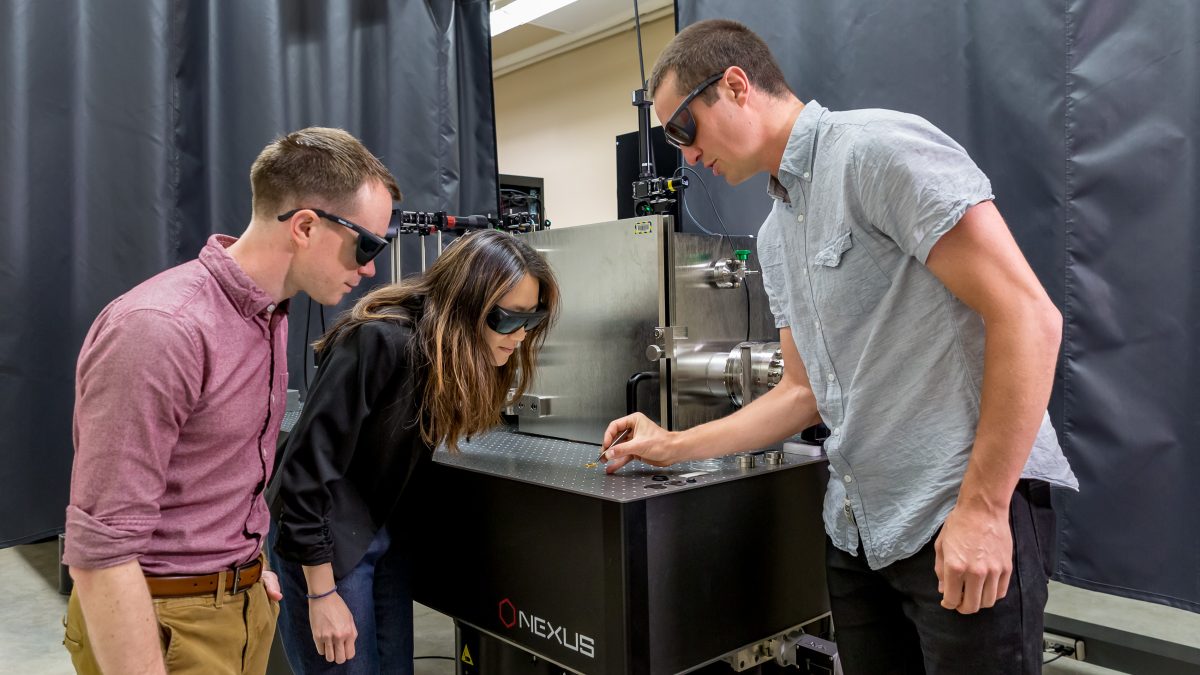
Featured image: Assistant Professors Eric Tervo (left), Jennifer Choy (center) and Dakotah Thompson (right) at the Wisconsin Center for Semiconductor Thermal Photonics. Credit: Joel Hallberg.
Written by: Sarah Perdue
Originally published to UW News. Read the full article here.